 Raydium
 fees connect pool charges, token deductions, and Solana costs to the final swap output
Raydium fees begin with the trading charge attached to each pool in a swap route. The final wallet change can also reflect Solana’s transaction fee, an optional priority fee, a Token-2022 transfer fee, and a rent-exempt deposit when a new token account is created. Price impact changes the exchange result without being a fee, while slippage sets the worst acceptable execution boundary. Reconcile these items against the confirmed transaction, not the quote alone.
Charges that enter a Raydium quote
Three cost layers can affect the exchange: pool-level charges, token-level deductions, and Solana execution costs. They arise from different mechanisms, may use different assets, and should not be combined as though they were one percentage.
The pool trading charge
Each pool applies its configured trading fee to the relevant side of a swap. A route that crosses several pools can incur a pool charge at each hop. The quote accounts for those deductions while calculating expected output, so a visible route provides more useful information than one headline rate.
Pool configuration matters. Raydium supports different pool programs and fee settings, while some CPMM pools may also enable a separate creator fee. Configurable and dynamic values should be read from the live route rather than treated as permanent protocol-wide constants.
Token-level deductions
A Token-2022 mint can charge its own transfer fee when tokens move into or out of a pool. That deduction belongs to the token’s mint configuration, not the pool’s trading-fee schedule. If both sides carry transfer fees, each transfer must be considered separately because the rates and caps can differ.
Network and account costs
The transaction fee is paid in SOL by the designated fee payer. A priority fee may be included to improve scheduling during congestion, but it does not buy a better exchange rate. A transaction may also fund a new associated token account for the output mint. That rent-exempt balance is an account deposit rather than a percentage charged by Raydium.
Terms that keep the cost lines separate
The quote contains several related figures, but each describes a different part of the proposed exchange. Reading them separately prevents price movement from being mislabeled as a protocol fee.
Expected and net output
Expected output is the amount calculated from the selected route and its current pool state. For a transfer-fee token, distinguish the pool’s gross outgoing amount from the net amount expected in the receiving token account. The net figure is the better basis for comparing routes.
Price impact
Price impact is the change in execution price caused by consuming available liquidity along the route. It is reflected in the quoted exchange result, but no recipient collects it as a fee. A larger trade can face greater impact when it moves farther through a pool’s pricing curve.
Slippage tolerance
Slippage tolerance creates an execution boundary around the quote. It does not predict the final difference and does not alter the configured pool rate. A wider tolerance permits execution after a larger adverse change, while a tighter setting may cause the transaction to fail if the route moves before processing.
Why can the quoted output differ from the wallet balance?
A quote is a snapshot of pool state, route selection, token rules, and transaction settings. Those inputs may change before execution. The final balance can therefore differ because the route moved within the permitted boundary, a Token-2022 deduction applied, or the transaction created a token account.
Successful confirmation establishes what executed, but the transaction record still needs interpretation. Compare the input-token decrease, output-token increase, SOL fee, and any new account funding. A wallet’s fiat estimate can move independently, so it should not replace raw token and SOL balance changes when reconciling cost.
A four-stage cost trail
A predictable comparison uses the same cost categories before and after execution. Record the expected input, net output, token deductions, and network estimate before signing. After confirmation, match those expectations to the observed balance changes and transaction record.
| Stage | Cost evidence | Control and custody |
|---|---|---|
| Quote review | The route shows expected input and output, pool charges, price impact, and any surfaced token deductions. | The assets remain under the wallet’s authority because no exchange transaction has been authorized. |
| Execution | The signed transaction carries the route instructions, execution boundary, and Solana fee settings. | The wallet authorizes only the accounts and instructions contained in that transaction. |
| Output confirmation | Status, token balance changes, and the charged network fee show whether settlement occurred. | The programs update the named token accounts within the signed transaction’s constraints. |
| Reconciliation | The confirmed deltas are compared with the quote, transfer deductions, and account funding. | No new authorization is required to inspect the public record and wallet-controlled balances. |
If observed output is below the quoted net amount but still within the protected boundary, market movement may explain the difference. A separate token deduction or account deposit should appear in its own balance change. An unexplained gap calls for transaction-level review rather than an assumption that the pool charged an extra rate.
Pool selection changes the trading charge
A route can use one pool, cross several pools, or divide an exchange across available liquidity. Each structure combines fee rates with reserve depth and execution price. A pool with a lower configured rate may still produce less net output if its available liquidity creates greater price impact.
Raydium splits the trading fee among liquidity providers and protocol destinations rather than charging each destination as a separate user fee. That internal allocation does not turn one trading charge into several additions to the quote. An optional creator fee, when enabled for a compatible pool, remains a distinct configured charge.
Because pool parameters and route composition can change, the selected quote is the relevant cost statement for a proposed exchange. Hard-coding a familiar tier can miss another pool, an updated configuration, or a route that crosses multiple fee settings.
Token-2022 deductions sit outside the pool fee
Token-2022 transfer fees follow the mint’s rules and apply when the token program processes a transfer. The pool does not choose the rate, cap, or withdrawal authority for that deduction.
Inbound transfers
An input-side transfer fee reduces the quantity that reaches the pool vault. Swap math must use the amount received by the vault rather than the nominal amount leaving the wallet. Otherwise, both the expected output and the apparent pool charge will be overstated.
Outbound transfers
An output-side fee is withheld when the pool sends tokens to the receiving account. The pool’s gross output and the wallet’s net receipt are therefore different values. A Token-2022 mint can apply a transfer fee with a percentage rate and a maximum charge per transfer.
Configuration changes
The transfer-fee configuration authority can schedule a rate and cap update that takes effect two epochs later under Token-2022’s rules. A quote should use the applicable configuration for its execution horizon. Refreshing a stale quote is especially important when a token-level fee can change, because old net-output expectations may no longer match the transaction that is built.
Compatibility also belongs in the cost review. A route must support the mint extensions needed for the transfer. If the selected program cannot process them, the exchange should not be treated as a costly success or estimated by simply subtracting a percentage.
Solana costs belong to the transaction
Solana charges the fee payer for processing the signed transaction. The base fee depends on the signatures that the message requires, while an optional priority fee depends on the transaction’s compute-budget settings. Both are separate from the pool’s token-denominated charge.
Solana deducts the transaction fee before execution, so a failed transaction can still consume its network fee. A higher priority setting can improve the chance of timely scheduling, but it cannot deepen pool liquidity, reduce price impact, or change the quoted pool rate.
A missing output-token account creates another SOL movement when the transaction funds its rent-exempt balance. The account owner may later recover eligible lamports by closing an empty token account under the applicable authority rules. Until then, reconciliation should identify the deposit separately instead of reporting it as a permanent trading fee.
Price impact changes cost without creating a fee
Price impact measures how the proposed exchange moves through available liquidity. The quote may cross multiple price ranges or pools, so the average execution rate can differ from the rate near the start of the route. That difference reduces economic output even though it is not transferred to a fee recipient.
Use net output to compare the combined effect of pool charges and price impact. Then keep Solana costs and account funding in their original SOL units unless a clearly defined valuation point converts them. Mixing changing fiat estimates with token quantities can create a larger apparent discrepancy than the transaction produced.
Failed and stale transactions need separate accounting
A processed transaction that fails can charge its Solana fee without applying the swap’s token-state changes. In that case, no pool trading fee or token transfer fee should be recorded as though settlement succeeded. The failure status and unchanged token balances distinguish the network charge from an executed exchange.
An expired or never-processed submission is different from an on-chain failure. Check whether a transaction record exists before assigning a charge. If another attempt is needed, obtain a fresh quote because pool state, transfer-fee configuration, and priority conditions may have changed. Each processed retry can create its own network fee.
Reconcile the settled exchange by balance delta
The confirmed transaction supplies the most reliable record of the amounts that moved. Reconciliation works best when each balance change is assigned to the mechanism that produced it:
- the input-token decrease, including any inbound transfer deduction;
- the output-token increase after any outbound transfer deduction;
- the pool charge incorporated into the route’s execution math;
- the Solana base and priority fees paid by the fee payer; and
- any SOL deposited into a newly created token account.
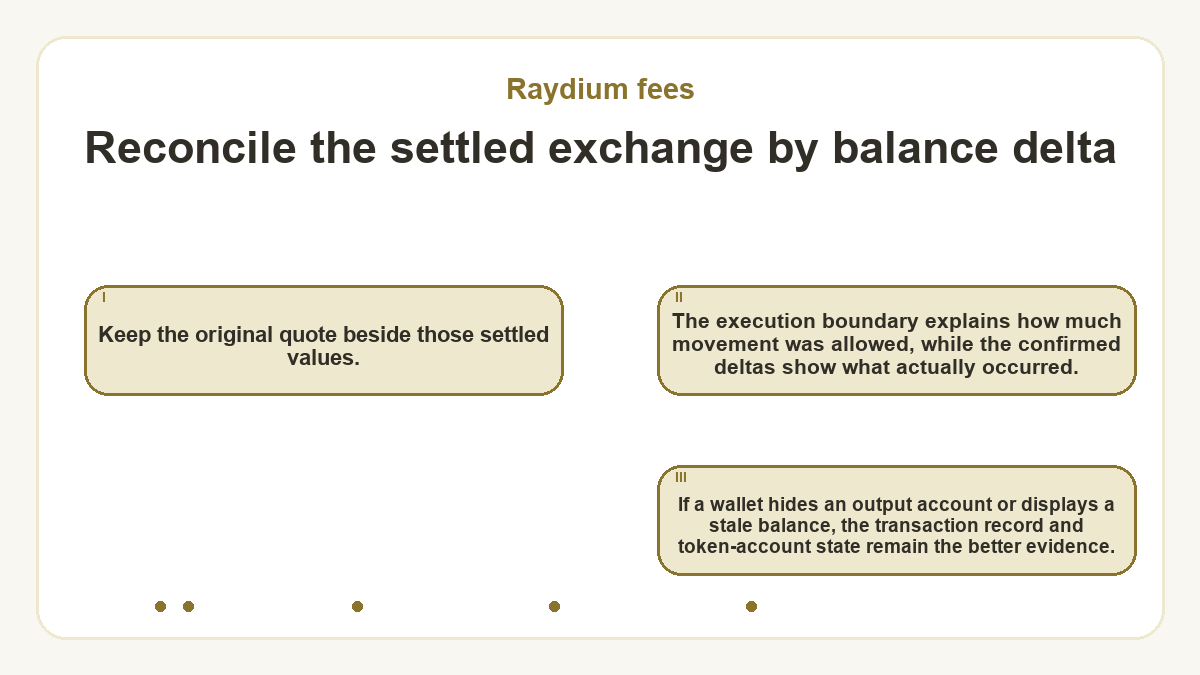
Keep the original quote beside those settled values. The execution boundary explains how much movement was allowed, while the confirmed deltas show what actually occurred. If a wallet hides an output account or displays a stale balance, the transaction record and token-account state remain the better evidence.
Compare routes by settled net output for the same intended input, then account for network and account costs on the same valuation basis. A route advertising a lower pool rate is not automatically cheaper than one with deeper liquidity and fewer token-level deductions.
Common questions
Does opening or refreshing a Raydium quote incur a fee?
No pool fee is charged merely for requesting or refreshing a quote. A quote reads available route and pool information without executing the exchange. Charges arise when a signed transaction is processed, and pool or token deductions apply only if the relevant transfers execute. A wallet signature request should therefore be inspected as a transaction action, not treated as part of ordinary quote retrieval.
How does exact-output mode change fee reconciliation?
Exact-output mode starts with the desired net receipt and works backward toward the required input. The calculation must account for pool charges, price movement along the route, and any applicable transfer fee on either token. Because those inputs can change before execution, the transaction uses a maximum-input boundary. Reconciliation compares the actual input spent with that boundary and confirms that the requested output reached the receiving account.
Are creator fees present in every Raydium CPMM pool?
No, a creator fee is an optional CPMM configuration rather than a universal charge. Its activation and charged side depend on the pool’s stored settings, while its rate comes from the pool’s current AmmConfig. The creator portion remains separate from the ordinary trading-fee bucket, so a comparison should use the fee details attached to the selected pool. A familiar CPMM trading rate does not prove that the creator-fee setting is disabled.
Does raising slippage increase the Raydium pool fee?
No, changing slippage tolerance does not alter a pool’s configured trading-fee rate. It widens or narrows the execution boundary around the quote. A wider boundary may allow settlement after a larger adverse price movement, which can reduce the output received even though the listed pool rate is unchanged. Slippage should therefore be treated as a price-protection setting, not an additional fee percentage.
Which route is cheaper when hop counts differ?
The cheaper route is the one that produces the better net result after every pool charge, token deduction, and price impact is included. More hops can add pool charges, but they may also access deeper liquidity and improve execution. Compare routes using the same input and current quote, then add transaction and account costs consistently. Hop count alone cannot establish which route has the lower total cost.